
Bibliography Background About KRIS
Sediment and Atlantic Salmon Habitat
Excess sediment can profoundly effect the productivity of a salmon or trout stream (Cordone and Kelly, 1961; McNeil and Ahnell, 1964; McHenry et al., 1994). The habitat complexity of a stream may be greatly compromised if there is a high sediment supply and negative effects extend to spawning, egg and alevin survival, rearing habitat and adult holding habitat (Frissell, 1992). The Maine Atlantic Salmon Technical Advisory Committee (Dill et al., 2002) recognized sediment from "cumulative non-point source pollutants, including increased turbidity and sedimentation from land use factors" as a potential limiting factor for the Gulf of Maine Atlantic salmon.
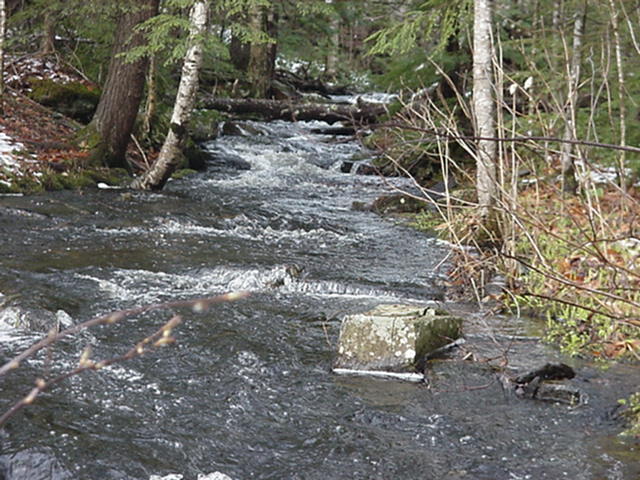 Atlantic salmon fry prefer to hold stations over gravel substrate (1.6-6.4 cm), while older parr prefer cobble or boulder substrate larger than 26 cm (Danie et al., 1984). Armstrong et al. (2004) found that no age class of juvenile Atlantic salmon shows affinity for sand substrate. In a healthy stream, young salmon and trout hide in the interstitial spaces between cobbles and boulders to avoid predation and to avoid the extreme cold of winter surface flows (Heggenes, 1990) . Waters (1995) found that excess fine sediment diminished Atlantic salmon habitat and also reduced food resources. Sediment caused a loss of pool depth, where both adults and juveniles may reside, and filled interstitial spaces between stream cobble and gravel blocking juvenile use of that area for cover, and decreased aquatic invertebrate production. Photo: Atlantic salmon parr rearing habitat. Photo by Melissa Halsted, SVCA.
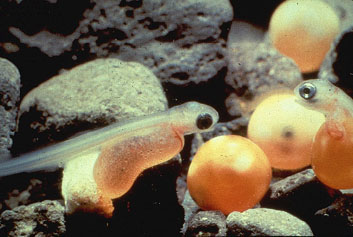 Atlantic salmon eggs and alevin have prolonged potential exposure to winter sediment transport because while eggs are laid in October or November, fry do not usually emerge until May of the following year, since low water temperatures prolong gestation (Baum, 1997). Atlantic salmon redds are usually 25 cm deep in the gravel and need a steady flow of clean, cold water to deliver oxygen and remove waste products. Soulsby et al. (2001) found in a Scottish River that when fine sediment less than 2 mm in size reached levels of 20%, egg mortalities were as high as 86%. Crisp and Carling (1989) compared fine sediment less than 1.0 mm in three streams in the United Kingdom and found average levels of 11% in the northeast, 8% in southwest Wales and 12% in Dorset. Individual samples rarely exceeded 20% fines.
Chapman (1988) showed different responses to similar levels of fines from various field studies (Figure 5 from Chapman) and noted that laboratory experiments might not duplicate redd dynamics. Studies conducted in actual redds in Olympic Peninsula streams in Washington found that if more than 13% fine sediment (<0.85 mm) intruded into the redd, almost no steelhead or coho salmon eggs survived (McHenry et al., 1994). Barnard (1992) showed that fine sediment levels inside and outside coho salmon redds varied substantially in Freshwater Creek, a northwestern California watershed. Fines (<1 mm) averaged seven percent inside redds and 13% outside them, with no inside redd measurement in excess of 13%. Even if female salmon remove sediment from redds, Armstrong et al. (2004) note that transport of sediment during winter may re-infiltrate redds before fry emerged. Because the redd is a depression in the stream bed, it creates Venturi forces, drawing water down into the gravel. Fine sediment in suspension during storms may be sucked down into the redd.
Particles of less than 6.4 mm have the potential to infiltrate redds and form a layer in the stream gravel that sometimes prevents emergence of fry (Lisle, 1989). Kondolf (2000), in a review of the literature, found that when fines (<6.4 mm) exceeded 30% salmonid emergence and survival was reduced by 50%. Barnard and McBain (1994) suggested that measuring permeability itself might be a quicker, and more cost effective, method of measuring sediment impacts on salmonids.
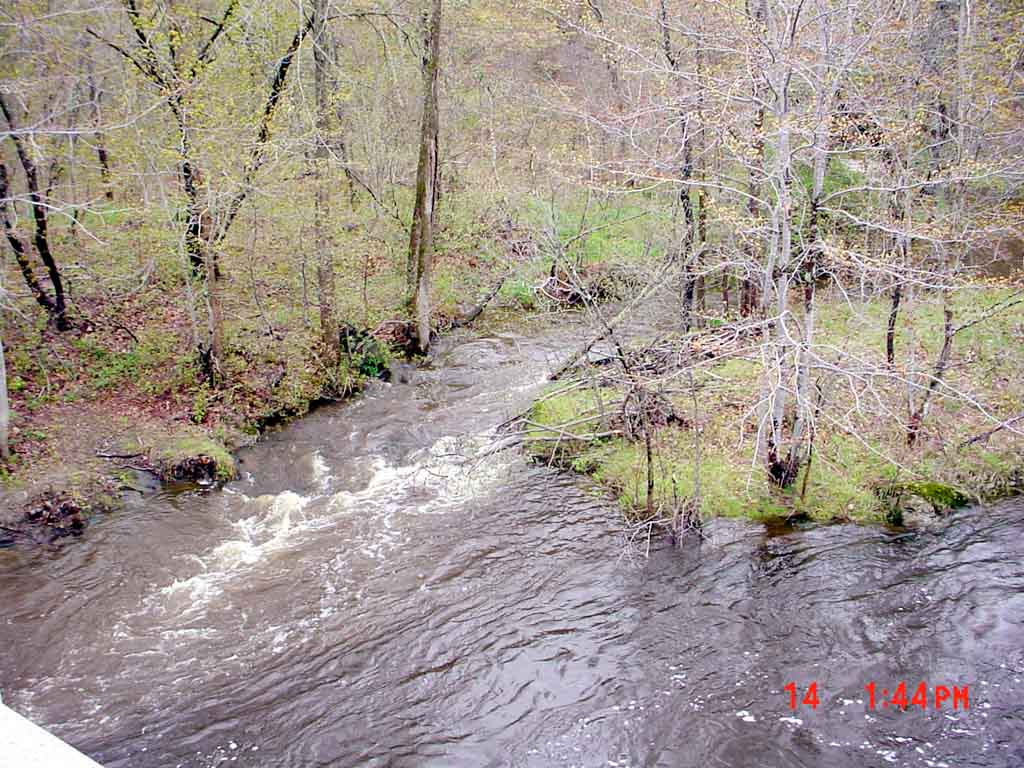 Total suspended solids (TSS) and turbidity in the Gulf of Maine Atlantic salmon rivers are a concern (Dill et al., 2002) particularly in the Sheepscot River (Arter, 2004). High turbidity impacts the feeding ability of juvenile salmon, although it may also provide them some cover from predation if it occurs during periods of smolt migration (Danie et al., 1984). Dill et al. (2002) cited Newcomb and Jensen (1996) when noting "that more than 6 days of exposure to TSS greater than 10 mg/l is a moderate stress for juvenile and adult salmonids. A single day of exposure to TSS in excess of 50 mg/l is also a moderate stress." Sigler et al. (1984) found that turbidities of 25 nephlometric turbidity units (ntu) or greater caused a reduction in juvenile salmonid growth. The longer the duration of high turbidity the more damage is likely to fish and other aquatic organisms (Newcombe and MacDonald, 1991). As noted by Arter (2004): "Even moderate turbidity may affect a fish’s ability to find food." Arter (2004) also recommended that any prospective sites for Atlantic salmon stocking be monitored for water quality, including turbidity. Photo: Finn Brook (at left) exhibits higher turbidity than the Sheepscot River. Photo by Melissa Halsted, SVCA. 128 KB
Lisle (1981) noted that recovery of streams with high gradient proceeds much more rapidly following large flood events than ones with low gradient. Gulf of Maine rivers are of mild gradient particularly in their lower reaches; consequently, sediment may remain in storage for longer periods. Watts et al. (2003) noted the need for regional, strategic sediment monitoring to prevent damage to fisheries resources.
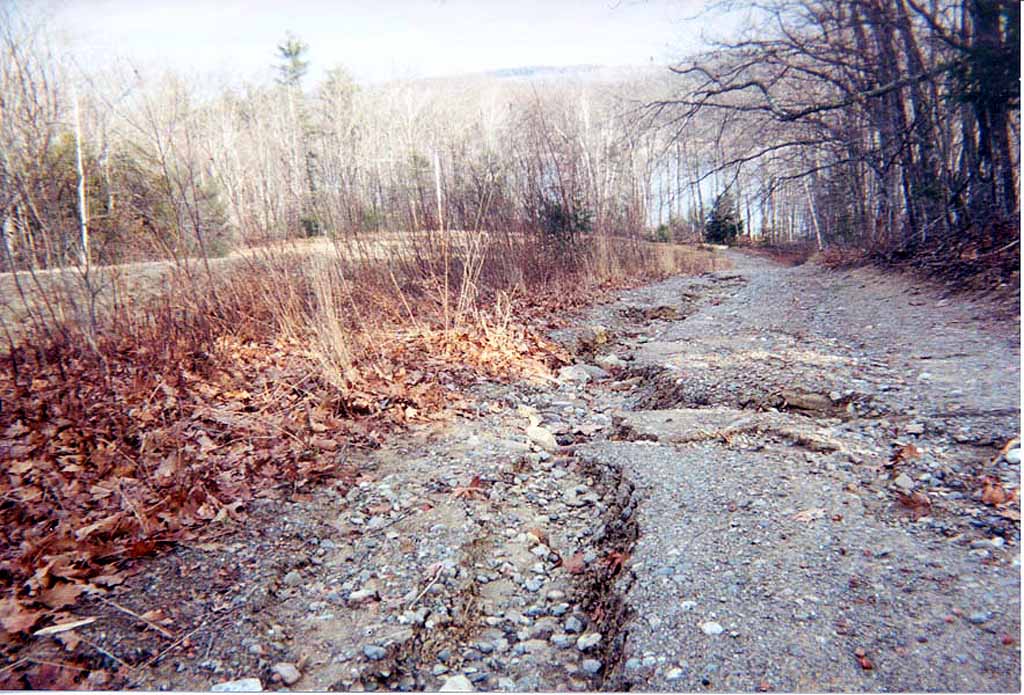 Roads are recognized as a major sediment source potentially affecting Gulf of Maine Atlantic salmon rivers (Dill, 2002):
"Seasonal roads are prone to NPS pollution due to erosion on the road surfaces, roadside ditches, or bank erosion at stream crossings. Of the NPs pollution sites identified in the Project SHARE database, most are eroding roads or stream crossings. These cause localized water quality and embeddedness problems in the salmon rivers."
Photo Gully erosion on abandoned road in Sheepscot basin. Photo by Melissa Halsted, SVCA.
See Roads and Upland Sediment Sources in Maine DPS Atlantic Salmon Watersheds Background page for more information.
References
Armstrong, J.D., P.S. Kemp, G.J.A. Kennedy, M. Ladle and N.J. Milner. 2004. Habitat requirements of Atlantic salmon and brown trout in rivers and streams. Fisheries Research 62 (2004), p. 143-170.
Arter, B. S. 2004. Sheepscot River Water Quality Monitoring Strategic Plan: A guide for coordinated water quality monitoring efforts in an Atlantic salmon watershed in Maine. Prepared for the Project SHARE: Research and Management Committee. 84 pp. [975kb]
Barnard, K. 1992. Physical and Chemical Conditions in Coho Salmon (Oncorhynchus kisutch) Spawning Habitat in Freshwater Creek, Northern California. Masters Thesis. Humboldt State University. Arcata CA. 81 pp. without appendices. [740 kb]
Barnard, K. & S. McBain. 1994. Standpipe to Determine Permeability, Dissolved Oxygen, and Vertical Particle Size Distribution in Salmonid Spawning Gravels. As FHR Currents # 15. US Forest Service, Region 5. Eureka, CA. 12 pp. [1.4 Mb]
Baum, E. (1997). Maine Atlantic Salmon: A National Treasure. Hermon, ME:, Atlantic Salmon Unlimited. 224 p.
Chapman. D.W. 1988. Critical Review of Variables Used to Define Effects of Fines in Redds of Large Salmonids. Transactions of the American Fisheries Society. 117: 1-21.
Cordone, A.J. and D.W. Kelley. 1961. The influences of inorganic sediment on the aquatic life of streams. Reprint from California Fish and Game. Vol. 47, No. 2. California Department of Fish and Game, Inland Fisheries Branch. Sacramento, CA. 41 pp. [155k]**
Crisp, D.T. and Carling, P., 1989. Observations on siting, dimensions and structure of salmonid redds. J. Fish Biol. 34, 119–134.
Danie, D.S., J. G. Trial, and J. G. Stanley. 1984. Species profiles: life histories and environmental requirements of coastal fish and invertebrates (North Atlantic) -- Atlantic salmon. U.S. Fish Wildlife Service.. FWVOBS-82/11.22. U.S. Army Corps of Engineers, TR EL-82-4. 19 pp. [500kb]
Dill, R., C. Fay, M. Gallagher, D. Kircheis, S. Mierzykowski, M. Whiting, and T. Haines, 2002. Water quality issues as potential limiting factors affecting juvenile Atlantic salmon life stages in Maine rivers. Report to Maine Atlantic Salmon Technical Advisory Committee by the Ad Hoc Committee on Water Quality. Atlantic Salmon Commission. Bangor, ME. 28 pp. [162kb]
Frissell, C.A. 1992. Cumulative effects of land use on salmonid habitat on southwest Oregon streams. Ph.D. thesis, Oregon State University, Corvalis, OR.
Heggenes, J. 1990. Habitat utilization and prefernces in juvenile Atlantic salmon in streams. Regulated Rivers Research and Management, Vol. 5, p. 341-354.
Kondolf, G.M. 2000. Assessing Salmonid Spawning Gravel Quality. Trans. Am. Fish. Soc. 129:262-281. [Note: Only the abstract is provided on-line]
Lisle, T. E. 1981. Channel recovery from recent large floods in north coastal California: rates and processes. Pages 153-160, in: R. N. Coates (ed.), Proceedings, Symposium on Watershed Rehabilitation in Redwood National Park and Other Pacific Coastal Areas; 25-28 August 1981; Arcata, California. Sacramento, California: Center for Natural Resources Studies of JMI, Inc. [92k]
Lisle, T. E. 1989. Sediment transport and resulting deposition in spawning gravels, north coastal California. Water Resources Research 25(6): 1303-1319. [487k]
McHenry, M.L., D.C. Morrill and E. Currence. 1994 . Spawning Gravel Quality, Watershed Characteristics and Early Life History Survival of Coho Salmon and Steelhead in Five North Olympic Peninsula Watersheds. Lower Elwha S'Klallam Tribe, Port Angeles, WA. and Makah Tribe, Neah Bay, WA. Funded by Washington State Dept. of Ecology (205J grant).
McNeil, W. J. and W.H. Ahnell. 1964. Success of Pink Spawning Relative to Size of Spawning Bed Material. U.S. Fish and Wildlife Service, Special Scientific Report - Fisheries No. 469. Washington, D.C. 17 pp.
Newcombe, C.P. and D.D. MacDonald. 1991. Effects of Suspended Sediments on Aquatic Ecosystems. North American Journal of Fisheries Management. 11: 72-82.
Newcombe, C. P. and J. O. T. Jensen. 1996. Channel suspended sediment and fisheries: a synthesis for quantitative assessment of risk and impact. No Amer. Fisheries Man 16 (4):693-719).
Sigler, J.W., T.C. Bjornn and F.H. Everest. 1984. Effects of Chronic Turbidity on Density of Steelheads and Coho Salmon. Transactions of the American Fisheries Society, 113: 142-150. [Note: Only the abstract is provided on-line]
Soulsby, C., A. F. Youngson, H.J. Moir and I.A. Malcomb. 2001. "Fine sediment influence on salmonid spawning habitat in a lowland agricultural stream: a preliminary assessment." The Science of the Total Environment. 265(1-3): 295-307.
Waters, T.F. 1995. Sediment in streams: sources, biological effects and control. American Fisheries Society, Bethesda, Md. 251 p.
Watts, C., P.S. Naden, D.M. Cooper, B. Gannon. 2003. Application of a regional procedure to assess the risk to fish from high sediment concentrations. Science of the Total Environment (2003). 15 p.