Bibliography Background About KRIS
Big River History: Big River Was Dammed
 Excerpts from Big River was Dammed
By W. Francis Jackson
FMMC Books, P.O. Box 232, Mendocino, CA 95460
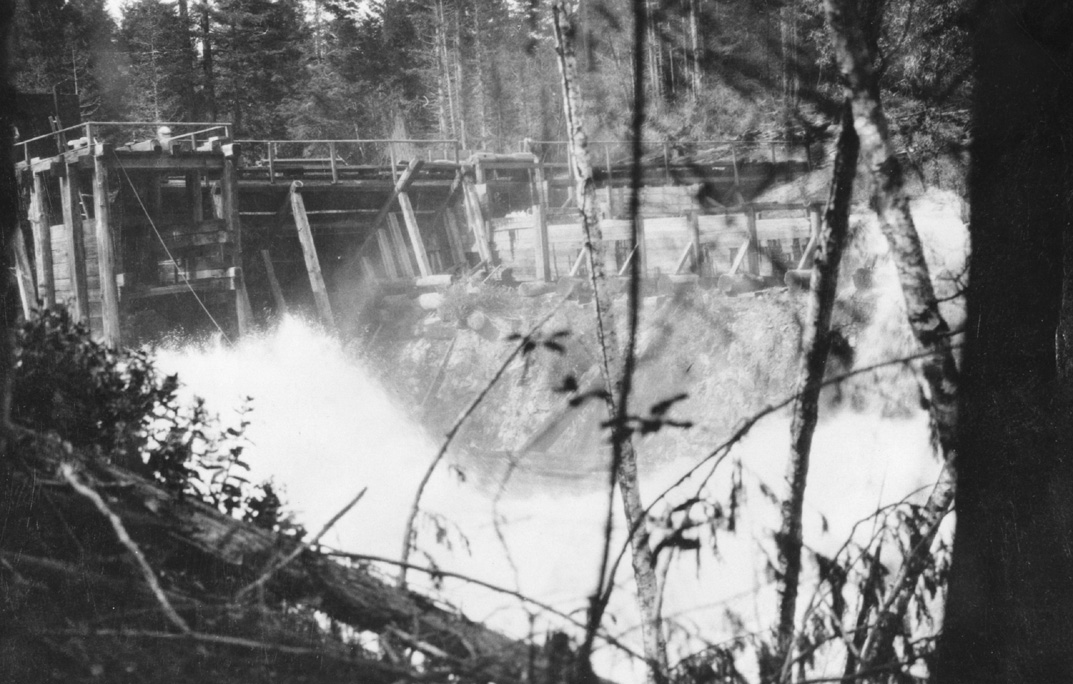
Photo: North Fork Big River Dam spilling water. Spring 1925. All photographs on this page courtesy of the Mendocino Historical Society and the Held Poage Memorial Home and Research Library (from the Collection of Robert Lee), except where noted. Use must be approved by the Mendocino Historical Society. Click on image to see at full size.
Introduction (I Remember): "On the (Big) River, men working presented another aspect to the lumbering engagement. They were doing their tasks from floating logs, rowing boats, operating sinker machine and dragsaw rafts and yes the Maru (tugboat). At the mill or at the Boom some distance up river, men would be guiding logs to the next step of transformation from one form to another. Amidst the bank-to-bank work area along the river we would fish, principally with Mervyn Swanson and my brother, Kenneth. At other times Kenneth and Raymond Nicholson, Emery and William Escola would be companions at catching trout, perch, whiting and herring just to name a few. At times trolling for salmon was interrupted by having to get out of the river channel in order to let the Maru and a load of logs go by."
Note (not an excerpt): Upper-most dam on the Big River was 48 miles upstream of the mouth and logs were rafted this entire length. Timing of dam releases was tightly scheduled to coordinate flows as log rafts reached various areas along their route. Construction of these dams began in about 1860 and continued through 1924. Some remained in use through 1943 when the last raft of logs was floated down the North Fork Big River. CDFG destroyed the last dam that blocked the river in 1945.
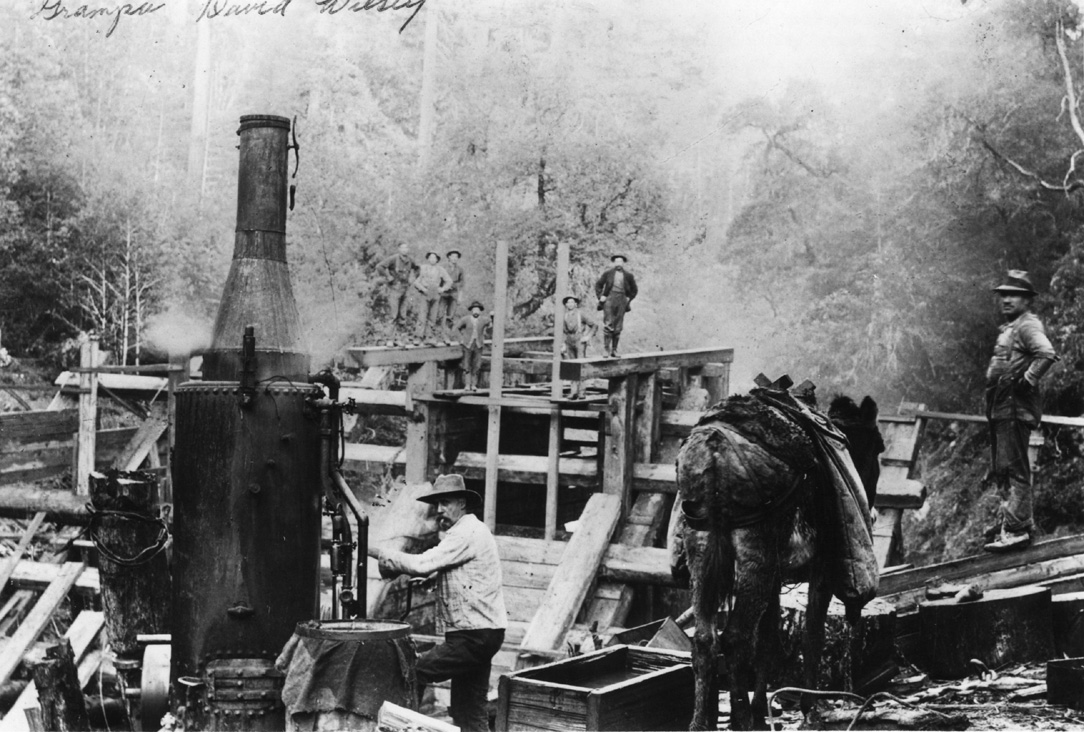 Introduction (P 2): It has been stated that there were more logging dams on Big River than on any other stream on the Redwood Coast. All evidence to date confirms the existence of 27 permanent type dams. Twenty-two can be verified from remaining physical evidence.
Basically there were three types of dams. The splash dam, sometimes called an upright dam, was the smallest. It was constructed to with a minimal amount of material and was used to provide water for the logs that have been placed in the stream down river from the dam.
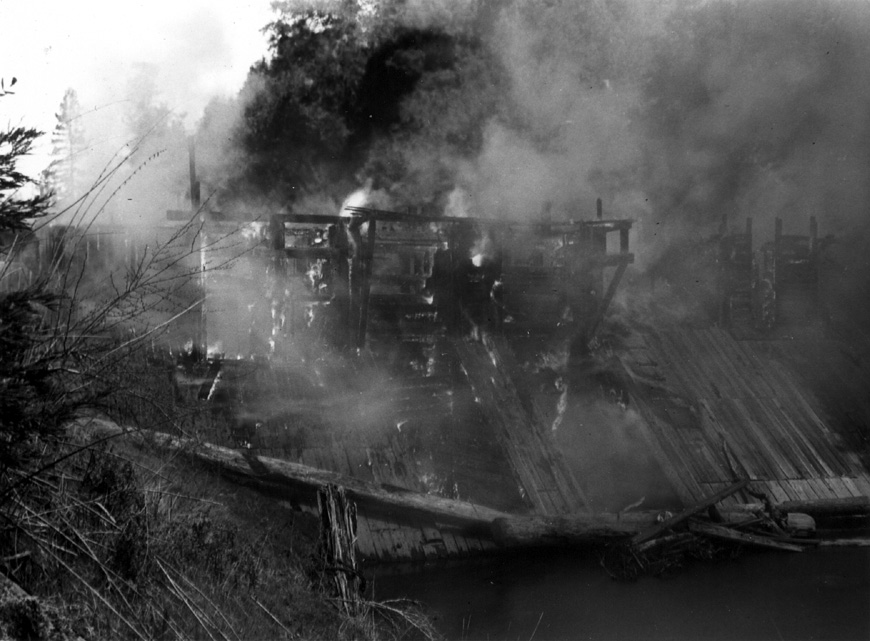 The crib dam and the frame dam or a combination of both was larger, more permanent structures. One of these dams used over a million board feet in its construction. They were in use for many years, not only to add water downriver, but also to float logs that had been placed in the river on the up-river side of the dam. In some instances, trees were felled directly into the lake above the dam.
A dam that left no remains was called a cutaway and was used only once. All of these dams had but one purpose-to get logs down the river. They are not to be confused with booms which were used to stop logs from coming downriver from going all the way our to sea.
Photograph above is from the Union Lumber Company-Georgia-Pacific Collection. Used with permission of the Ft Bragg-Mendocino Coast Historical Society.
P3: With rare exceptions, dams along Big River were used only during the winter season. Winter rains were supposed to furnish the freshet, but in most cases, did not. Dams were then used to build up a reservoir of water. When the dams were tripped, a flood was created along with a "head." A head is similar to the shore side of an ocean wave. Near the dam, a head might begin as high as 10 dropping to three-foot height 15 miles downriver. A higher head, which would result in being able to float more logs a greater distance, would be obtained by tripping more than one dam.
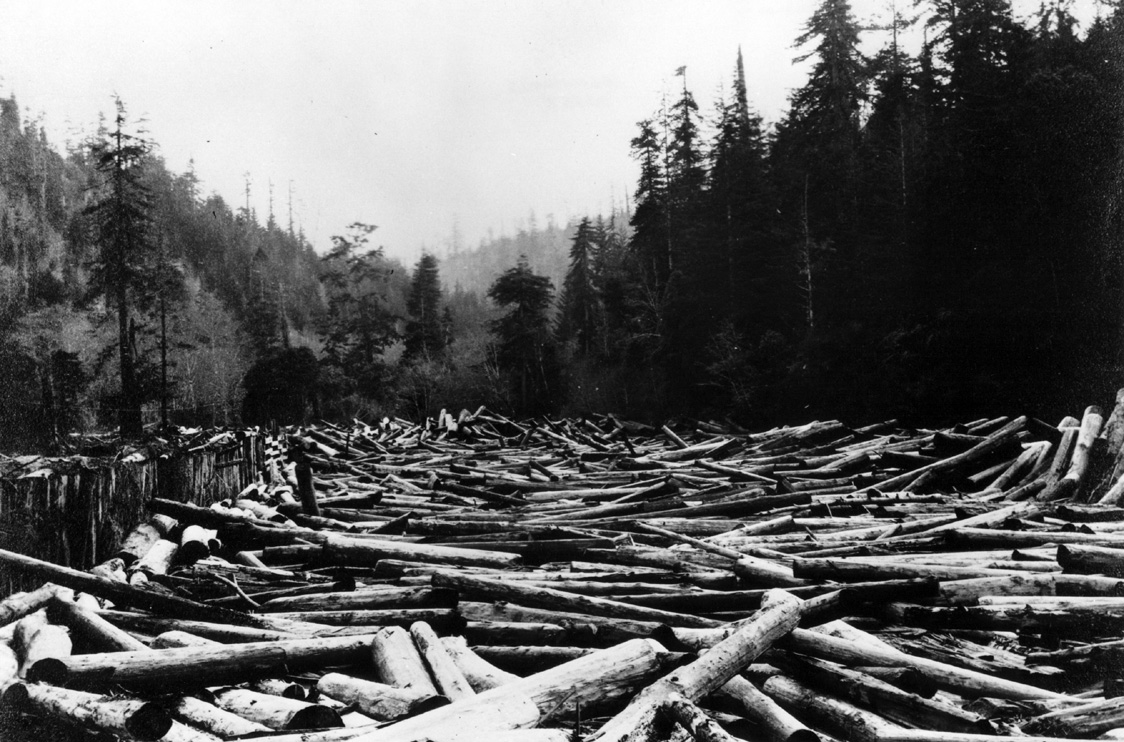 P 26: The South Fork (Big River) between Daugherty Creek and the Main River is known for its crookedness. It was the scene of many costly and prolonged logjams. One such jam effectively blocked the river for nearly five years. Logging crews were put out of work because there was no room to float additional logs. Overall, logging in the South Fork was almost continuous for 40 years." Logging on the South Fork ceased in about 1926 when Clyde Mallory closed down operations and sold his logging equipment to the Mendocino Logging Company. Compche Fire of 1931 started in the upper South Fork at a place called "Nigger Nat Opening."
P 27: "When the dam broke, all Hell broke loose. The water, the former jammed logs, and last but not least the dam, all went down the river. When the dam went, all evidence of its existence was removed." Hell Gate on the SF was a hairpin turn in the river and is thought to have been the site of one such dam.
Note (not an excerpt): When large jams formed in the river, a cutaway dam was built to float the logs in the jam and to re-orient them so they could be floated downstream. Then the cutaway dam was blasted with black powder or dynamite.)
P31 The first log drive on Anderson Gulch was a sight to behold, according to Clyde Mallory. He was there and had to do a little scrambling to get out of the way. What he saw was a wall of logs, trash, rocks and other debris that towered nearly 20 feet high. As he was on the lower side, no water was visible. It was behind the approaching mass, pushing the logs along in its attempt to get downstream. He said it was odd to see the dust flying as the logs in the drive sheared off sharp points on the streams banks.

Infrastructure - railroads, boats, bridges, etc.
Events - floods, storms, shipwrecks, etc
Logging / Mills - operations and events at mills, logging activities
Also see, Big River Was Dammed (excerpts) and Fish stories from the past